Document KJ-001 · First edition · September 2026

The Manifesto

A style is a dead man's answer to a question somebody asked him once, in a country you have never been to. Ask your own question.

Read this first

A synthesis, not a discovery

Every technique in Kingjutsu belongs to someone else. Okinawa, Korea, Brazil, Thailand, the Israeli military and the Filipino islands all paid for theirs. The original part is how the pieces are arranged, plus a code and a flat refusal to pretend we invented any of it.

A modern fight looks nothing like a duel. It is short and ugly, and somebody is usually filming it. It usually starts at talking distance, indoors on concrete, often with someone sitting down and someone else holding a phone. No single traditional art was built for that.

Call it an old practice rebuilt for the century it has to survive in.

Chapter I · 宣

The Declaration

Nine articles. If the art ever drifts, one of these got dropped along the way, and the fix is to put it back.

  1. 01

    The art is the student.
    The style is only furniture.

    No two bodies are built alike. The technique that passes the test on your frame is the right technique for you, and a tall student should never be made to fight like a short one.

  2. 02

    Nothing is inherited.
    Everything is tested.

    A technique earns its place by surviving live resistance from someone who really doesn't want it to work. It keeps that place for as long as it keeps surviving.

  3. 03

    Range decides the tool.
    Never the reverse.

    Kingjutsu trains all five ranges, from outside down to the ground, so the body answers the distance it is actually in rather than the one it likes.

  4. 04

    The first technique
    is the eye.

    Awareness is a trainable skill. It is also the only technique that works every time, because it gets you out of the building before anything starts.

  5. 05

    The best fight is the one
    that was refused.

    Leaving is the correct use of the art, and it is graded that way. A student who talks a situation down scores as highly as one who finishes it.

  6. 06

    A weapon is a lever,
    not an identity.

    Every classical weapon changes how far you reach or how much force you make. Each one teaches the empty hand something it would take years to learn alone.

  7. 07

    Train tired, train ugly,
    train small.

    Real trouble turns up at the end of a long day, in a corridor, at arm's length. So the session ends the same way, with everyone exhausted and cramped.

  8. 08

    The crown is
    worn inward.

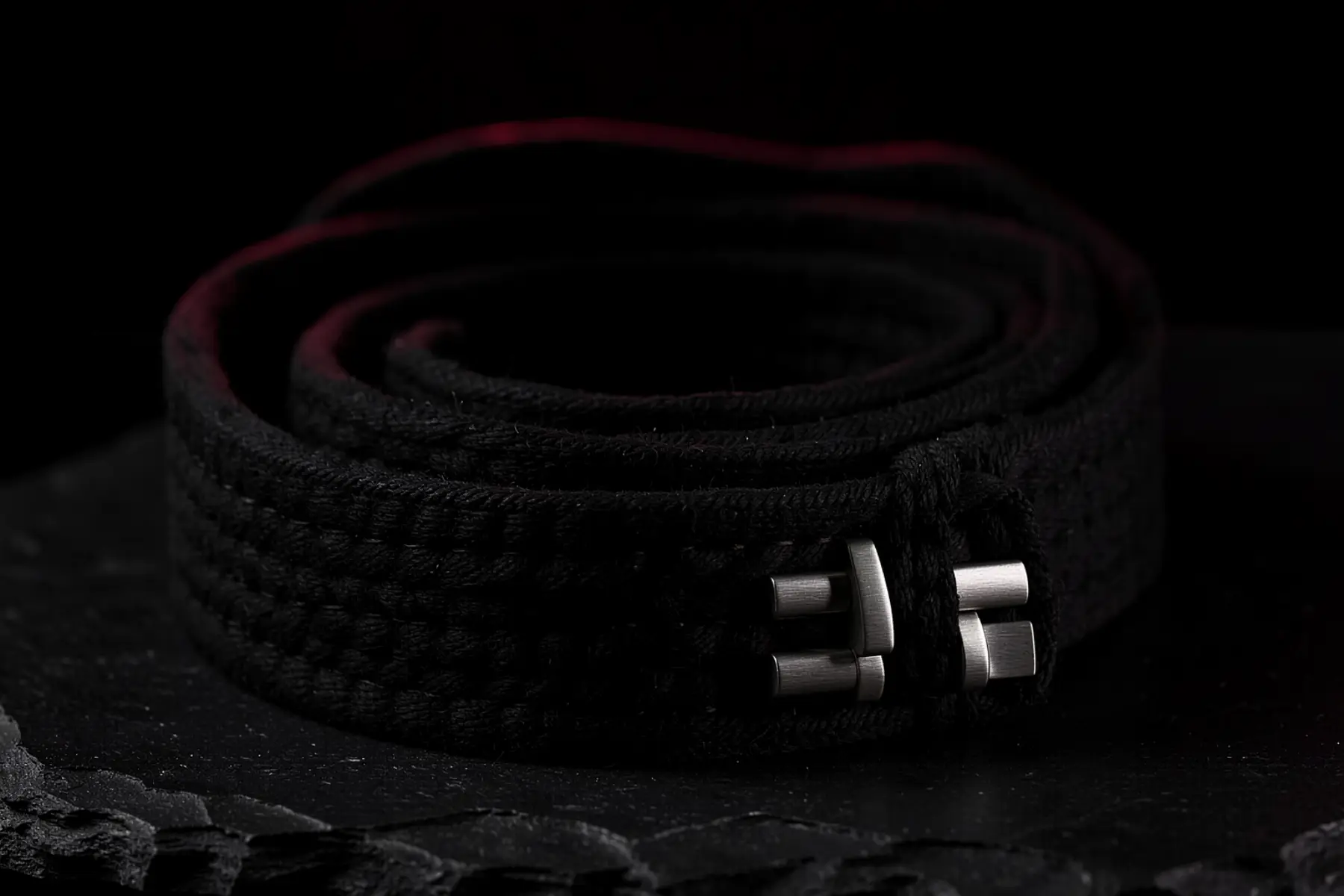
    The belt is black from the first day and stays black forever. What changes is what you can actually do under pressure. Nobody is called Master.

  9. 09

    No lord.
    Only the code.

    Every practitioner holds a licence issued by nobody, and only they can take it away from themselves.
破 · What we refuse

The Heresies

  1. We refuse the certificate.

    A grade is a claim, and anyone who turns up on a training night can test it.

  2. We refuse the family tree.

    Lineage is history. It has never got anybody out of a stairwell.

  3. We refuse the photograph on the wall.

    Respect the work. The man is not the work.

  4. We refuse the technique that has never met resistance.

    If it has never been done to somebody trying hard to stop it, it is choreography.

  5. We refuse “too deadly to spar”.

    The most expensive sentence in martial arts.

  6. We refuse the rainbow.

    One black belt from the first day. Earn a mark on it or don't.

  7. We refuse the style war.

    We took the striking and the grappling, and the weapons as well.

  8. We refuse the guru.

    Ask your instructor to show you slowly, against someone their own size.

  9. We refuse the franchise.

    The syllabus exists to make people capable. Selling the next grading is somebody else's business.

  10. We refuse to ask permission.

    We aren't applying to anyone. We train in public, where it can be checked.

Chapter II · 五門

The Five Gates

In the training programs each element is packaged as a range. Outside is 空 Void, Kicking is 火 Fire, Hand is 風 Wind, Clinch is 水 Water, Ground is 地 Earth. The weapons are the sixth element, 金 Metal. The gates are drawn as a pentagram rather than a ladder, so each one is braced by the two it does not sit beside.

Gate I of Five · The Gate of Structure · Ground range

地 Chi · Earth

Drawn from
Shotokan and Kyokushin karate, Goju-ryu, Wing Chun, Okinawan kobudo, Greco-Roman wrestling
What it gives you
Alignment. Putting the whole mass of a body through a very small area, and taking a hit like that without folding.
The lie it tells
That the floor will be flat and the opponent will stand in front of you.
Open the Ground range

Gate II of Five · The Gate of Control · Clinch range

水 Sui · Water

Drawn from
Brazilian jiu-jitsu, judo, catch and freestyle wrestling, sambo
What it gives you
Holding a bigger, angrier person still without hurting them. Above all, getting back up.
The lie it tells
That there is only one opponent and nobody's friend is walking over.
Open the Clinch range

Gate III of Five · The Gate of Violence · Kicking range

火 Ka · Fire

Drawn from
Muay Thai, boxing, Dutch kickboxing, Krav Maga, Lethwei
What it gives you
Elbows and knees in the clinch, and the trained willingness to get hit hard and keep working.
The lie it tells
That aggression is a strategy. This is the one gate a student can fail on character.
Open the Kicking range

Gate IV of Five · The Gate of Movement · Hand range

風 Fū · Wind

Drawn from
Taekwondo, savate, capoeira, silat, boxing footwork, parkour
What it gives you
Managing distance with the long tools, and being fit enough to leave. That means sprinting and getting over a fence.
The lie it tells
That a high kick is a good kick. A head kick bets that you won't slip.
Open the Hand range

Gate V of Five · The Gate of Mind · Outside range

空 Kū · Void

Drawn from
Kali, eskrima and arnis, the strategic tradition of ninjutsu, de-escalation, use-of-force law
What it gives you
Seeing the fight coming and finding the exit first. Talking people down. Knowing the law you will actually be judged under.
The lie it tells
None that is cheap, which is why it comes last.
Open the Outside range

Chapter V · 掟

The Code

The ladder of force. You may not skip a rung you had time to take.

  1. 01

    Presence

    Be seen and look like a bad choice.

  2. 02

    Voice

    Say it loud and say it more than once. The witnesses are listening too.

  3. 03

    Leave

    The right answer to almost every encounter.

  4. 04

    Obstruct

    Put a bag or a door between you. Always lawful and usually enough.

  5. 05

    Control

    Hold and restrain without injury.

  6. 06

    Strike

    Only to create the chance to leave or to hold. Never as the end in itself.

  7. 07

    Everything

    Only when death or serious harm is about to happen. If you are unsure, you are not on this rung.

Twelve strangers reading a transcript will judge you. Five friends watching a demonstration won't. Train for the transcript.

Chapter IV

The Obsidian Belt

Black from the first day. The belt does not lighten. You do.

GradeMarkTypical timeWhat it certifies
Mukan 無冠Plain black beltDay oneNothing yet, and the student is told so.
First to Fourth Bar1 to 4 steel bars9 to 18 months eachOne named gate each, tested live.
Rōnin 浪人5 steel bars6 to 9 yearsAll five gates held and re-tested in one year.
First Crown1 crimson thread+3 yearsLicensed to teach.
Second Crown2 crimson threads+4 yearsLicensed to grade to Bar.
Third Crown3 crimson threads+5 yearsLicensed to open a dojo under the name.
Fourth Crown4 crimson threadsLifetimeHas materially changed the art.
Fifth Crown5 crimson threadsBy unanimityAwarded for a body of work, not a body of skill.

Coloured belts came along in the twentieth century to keep students paying. They teach people to want the next colour instead of the next capability. Nobody here is called Master.

Chapter VI · Kata, rebuilt

The Five Modern Forms

Each form runs about ninety seconds. You learn it dry for precision, run it wet in a real space with partners, and get tested on it cold at the end of a hard session.

Open the forms course